

The housing discrimination history of America is not simply a record of individual prejudice. It is the story of laws, financial systems, public policies, and professional practices that determined who could own property, build wealth, and live in neighborhoods rich with opportunity.
Here are five defining moments that reshaped American housing, and whose effects remain visible today.
1. Emancipation Without Economic Independence
The abolition of slavery in 1865 promised freedom, but formerly enslaved families generally received neither land nor meaningful access to capital. Reconstruction briefly expanded Black landownership and political participation, yet racial violence, discriminatory laws, and dispossession soon undermined those gains.
Because property ownership became one of America’s primary routes to financial security, denying Black families equal access to land created an economic disadvantage that extended across generations.
2. Racial Zoning and Restrictive Covenants
During the early twentieth century, cities used racial zoning ordinances to separate Black and White residents. In 1917, the Supreme Court struck down explicit racial zoning in Buchanan v. Warley. However, exclusion did not disappear; it changed form.
Developers, neighborhood associations, and homeowners increasingly relied on racially restrictive covenants written into property deeds. These agreements prohibited homes from being sold or occupied by people of certain races. Although Shelley v. Kraemer made such covenants judicially unenforceable in 1948, they had already helped establish lasting patterns of segregation.
3. Redlining and the Federal Mortgage System
New Deal housing programs transformed American homeownership during the 1930s. Yet federal underwriting practices frequently treated Black residents and racially integrated neighborhoods as financial risks.
Redlining maps and discriminatory lending standards restricted mortgage access in many Black communities while directing capital toward predominantly White suburbs. Families excluded from affordable mortgages also lost decades of home appreciation, equity, and intergenerational wealth.
4. Urban Renewal and Highway Construction
Beginning in the mid-twentieth century, governments cleared neighborhoods labeled “blighted” to make way for highways, civic projects, and commercial development. Black communities were disproportionately displaced.
Urban renewal did more than demolish buildings. It disrupted businesses, churches, social networks, and locally accumulated wealth. Highways often divided surviving neighborhoods while exposing residents to pollution, declining investment, and physical isolation.
5. The Fair Housing Act and the Barriers That Adapted
The Fair Housing Act of 1968 prohibited discrimination in the sale, rental, and financing of housing. It was a landmark civil-rights achievement, but legislation alone could not erase the structures built over generations.
Modern discrimination may appear through steering, biased appraisals, unequal access to listings, exclusionary zoning, targeted advertising, tenant-screening tools, automated valuations, and institutional procedures that look neutral while producing unequal outcomes. The language has changed, but access can still be narrowed quietly.
Learn to Recognize the Gates That Remain
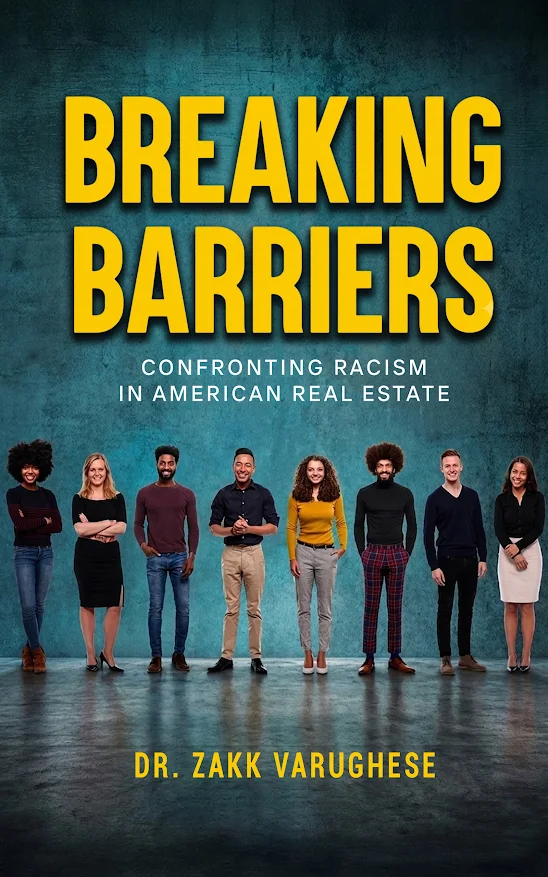
In Breaking Barriers: Confronting Racism in American Real Estate, real estate broker, educator, and advocate Dr. Zakk Varughese connects this history to the housing market people experience today.
Through documented history, professional insight, composite stories, and a practical framework built around six dimensions of housing opportunity, the book reveals how law, finance, geography, institutions, environmental conditions, and real estate professionals collectively shape who can buy, remain, prosper, and belong.
This is more than a history book. It is a guide for homebuyers seeking clarity, professionals committed to ethical practice, educators leading difficult conversations, and community members who want to recognize exclusion before it becomes another accepted pattern.
Get your copy today and examine the history, question the rules that appear neutral, and discover what it will take to create a housing system in which fairness is not exceptional, but expected.